Photo by Scott Pickering

Friday, November 19, 2010

God Be Praised / Gateway Worship

God Be Praised (Deluxe) from Gateway Worship is currently #7 on the iTunes Christian & Gospel chart. Thomas Miller, Walker Beach, and the team from Gateway have produced a “live” album with a “really live” feel.


It is an honor to be a part of this recent release. There are ample amounts of percussion from  my percussion colleague, Mark Levy and lil' ol' me. Click the  widget below for more info (including some samples).

                         www.gatewaywidget.com

 Listen for the rainstick in a couple of spots in “O The Blood.” …that’s me!

Monday, November 15, 2010

PASIC 2010

The Percussive Arts Society International Convention took place last week in Indianapolis. It was four days full of new gear, old friends, networking, inspiring performances, and the fun that can come from a few thousand drummers getting together.
Here I am with Bart Elliot (Nashville drummer and purveyor of drummercafe.com).

Since the early 80’s, my headed tambourine of choice has been manufactured by Grover Pro Percussion. Click this link (http://bit.ly/aULTnZ ) to find me at the Grover booth with the Heat-Treated Silver Dry 8” Tambourine.
Neil Grover (percussionist with the Boston Pops & owner of Grover Pro Percussion) and lil’ ol’ me.
And...I got out of bed and made it over to the 7:00 A.M. Breakfast Meeting of Fellowship of Christian Percussionists. 
PASIC 2011 will be held again in Indianapolis. For more info: www.pas.org

Monday, November 8, 2010

Mark Tree

More than a one trick pony…

Aren’t you glad that studio musician, Mark Stevens invented the mark tree back in the late 60‘s? Also know as bar chimes, the mark tree can help set an ethereal mood, wash into a half-time section, or sweep the music into a modulation.


The instrument is capable of more than the oft-used stereotypical high to low glissando.
 You can…
  • Glissando low to high
  • Glissando using a light touch with a triangle beater
  • Start in the middle with both hands and move outward in both directions slowly
  • Produce a burst of sound using both hands to quickly set all the cylinders in motion
  • Create a wind chimes effect ---gently moving the cylinders into one another
Resist the temptation to overuse the mark tree. Keeping this timbre rare maximizes the effect of its shimmering beauty.
When you invest in a mark tree, get a long one …and a supply of replacement ties!

Friday, October 8, 2010

Legato Shaker


During a recording session, I was using the Soft Shake from Latin Percussion (www.lpmusic.com/). I had been playing it in a conventional manner. The producer suddenly asked me to turn the shaker so that an end was toward me (as shown in the photo). Though slightly skeptical, I complied and immediately heard the difference. There was less attack in the sound and more length to each note. The length of this particular shaker is rather short so that you can control the rhythmic flow of the fill (beads) in this position. The “more legato” sound fit well in the song we were recording and I continue to use this technique when appropriate. This is one that requires close proximity to the microphone.

Friday, October 1, 2010

Which backbeat to play?

...2 or 4?

Doubling the snare drum back beat with a single strike on the tambourine is quite common and can give some variety to the groove. I usually choose one backbeat or the other; seldom do I play both 2 and 4. Less tedium and greater variety occurs when the snare drum is heard alone on one of the beats and the doubled sound on the other. Sometimes my choice is arbitrary but often I make a studied decision based on the lyrics of the song.


Listen to the phrasing of the lyrics and you will often find less vocal activity around either beat 2 or beat 4. Playing on that back beat allows the tambourine’s tone color to do its job without competing with the vocals.

Both lyric and tambourine get their space.

Friday, September 24, 2010

Chajchas

What are those things?

Really?


A staple of Andean folk music, the chajchas consist of goat hooves sewn to cloth loops. The chajchas produce a warm, earthy, clattering rattle (to my ear). The loops are traditionally worn around the wrist (like bracelets) so that a player can also play a bombo (drum) and chajchas together. I tape a couple of loops together, grasp the whole clump, and play downbeats with a quick downward flick of the wrist.

                     Some chajchas ideas:

  • When the drumset is laying down an ethno-groove on the toms, try bringing out the chajchas on some simple downbeats.
  • Play the backbeat (sparingly).
  • Shake the hooves for an ethereal effect.

Friday, September 17, 2010

Rock Cowbell

Tulp  Tulp  Tulp  Tulp

Sometimes that four to a bar / downbeat cowbell is just what the song needs. You hear it in so many styles...Rock, Funk, Pop, R&B. In contrast to many Latin styles where the cowbell has a more open / ringing sound, the Rock cowbell sound is generally a dry tone. I once read the tone described as “tulp.”

Grip the cowbell with the subdominant hand with the open end of the bell up and away from your body. The instrument rests in your hand so that the fingers and thumb are gripping the sides and the flat bottom rests against your palm. This grip allows you to achieve a dry sound with the palm stopping vibrations. If you need an open sound, drop your palm away from the bell (with fingers and thumb still clutching the bell on the sides).

If a consistent dry sound is needed, I sometimes grip the bell with fingers on the bottom (flat area) and my thumb on top of the playing surface. This grip allows me to apply some pressure for that “tulp.”


Strike the cowbell with the side of the stick (rather than the end) across the edge of the mouth. This seems to bring out more fundamental and less highs.

Go for the tulp!

Saturday, September 11, 2010

Stickball

Why didn’t I think of that?

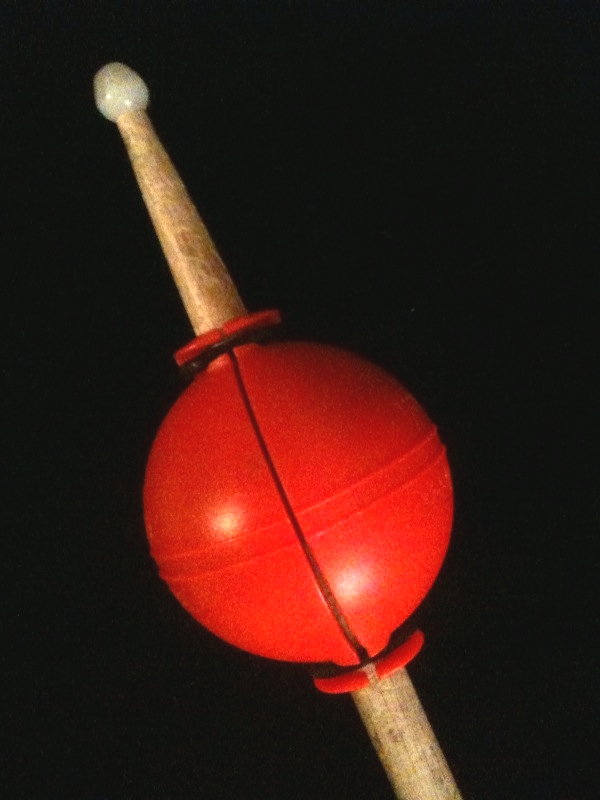
Don’t try to tape a shaker egg to a drumstick. Stop playing the cowbell with a maraca. The Stickball from Rhythm Tech (http://www.rhythmtech.com/) slides quickly and securely onto a range of shaft sizes and instantly allows you to add a shaker sound to a stick or mallet.
The video on the June 16, 2010 posting contains some Stickball playing.
 
Click on this link for Drummer Café (http://bit.ly/djC4qJ)  for a video review of the Stickball. 
 
 
Invest in a couple of Stickballs
...a creativity catalyst!

Saturday, September 4, 2010

Clean up the shaker attack

Do you ever notice some extraneous sound in that split second before you actually want the first shaker note to sound? You are probably giving the shaker a preparatory flick to bring the fill (beads) into the ready position area opposite the initial striking side. That “pre-attack” swish can mar the quality of a shaker track (or require some time with the digital editor).

You can eliminate most of the extrinsic clatter by simply bending your wrist so that the fill slides and settles into that ready position. If your first attack motion is away from your body, bend your wrist so that your thumb is closer to parallel to the floor and the fill in the shaker is resting right over your thumb. If your first attack is toward your body, bend your wrist so that your fingers are more parallel to the floor. When the rhythmic moment comes, use a normal shaker motion and the fill will move cleanly from its ready position and slap the striking area with a more precise sound.

Friday, August 27, 2010

Forte-piano Timpani Roll

Get Sneaky.

You can find the forte-piano timpani roll in hymn arrangements, oratorios, Brooklyn Tabernacle orchestrations, and many more church music styles.


If your usual method has been to play a loud roll and quickly bring the roll volume down, try this approach for a better tone (and less work).
  • Play a single forte stroke. The volume level of the resulting tone will begin to drop.
  • While the head is still ringing, bring in a soft roll under the volume of the ringing tone produced by the initial stroke.
  • With some practice, you can sneak in so that the beginning of the piano roll is masked by the sound of the decaying forte stroke.

Friday, August 20, 2010

Clave Rhythms


Clave patterns serve as rhythmic organizers in several Latin American and African styles of music. There are Bossa Nova, Afro-Cuban 6/8, Rhumba, Son claves and more! One of the more common is the Son clave. This five note pattern can be played in two versions, 3-2 and 2-3.
When playing in the rhythm section, it is crucial to know if a clave-based song is 3-2 or 2-3. This knowledge assists the players in selecting note groupings. Everyone should be playing “in clave.”


One way to determine the clave is to clap the 3-2 version while singing the melody of the song and repeat the melody with the 2-3 version. One of the clave rhythms will probably fit and feel better. (This suggestion comes from the book, Salsa Session by B. Sulsbruck, H. Beck, and W. Hansen.)


Saturday, August 14, 2010

Claves

Stay loose!

Claves may have originated with sailors using pegs from ship masts for musical accompaniment. Traditionally made of rosewood, the bright tone of the claves can cut through some dense musical textures.


Hold the striker clave in your dominant hand (in a loose matched grip). For the stationary clave, curl your fingers of your other hand in towards your palm with the thumb resting against the side of the index finger. You are forming a little echo chamber for the clave to resonate.


Lay the clave over your echo chamber and you are ready to play.
Gripping either clave tightly will inhibit vibrations. You will know when the grips are correct when the claves respond with a characteristically resonant tone. Stay loose (grip-wise)…and check back for a post about clave rhythms.

Saturday, July 24, 2010

Cabasa


  • Strike it.      
  • Scrape it.
  • Shake it.
  • Tap it for staccato.
  • Slide the beads for legato.  


       Lots of possibilities with the cabasa!

     Experiment with these patterns:


Saturday, July 17, 2010

Cajon


"Do you have a box?"
When Robert (a Peruvian) asked that question, I knew that he was referring to the cajon.  Simple, portable, and possessing a variety of timbres, the cajon is a great choice for the "no drumset" situation.  With bass tones produced in the center of the main playing surface (front panel) and crisp highs at the upper corners, you can coax a pretty meaty groove out of the box.

  • Most cajons have screws near the corners of the front panel. Loosen the screws to raise the corners for better slap.  I insert thin cardstock to soup up the slap.
  • Mike the sound hole for good bass tones.  A desktop mike stand comes in handy.
  • A piece of foam rubber resting on the bottom (inside) may help absorb some unwanted ring.
  • Experiment with the cajon for a variety of sounds.  Use the sides.   Play with different areas of your hands, knuckles, fist, etc...  Strike and scrape it with brushes.
  • I prefer a traditional cajon sound (without the snares).  You can obtain the snare effect by placing a snare drum on its side just behind the cajon sound hole.  Face the snare (bottom) head toward the cajon. 
One Good Lick For Cajon:

This pattern outlines the 3:2 son clave.   Start on beat 3 and proceed to beats 4, 1, & 2 and you can get the 2:3  feel.


Saturday, July 10, 2010

Looping Pedal / Practice Tool

Play it again…and again…and again…


Back in my grad school days in electronic comp class, we composed using loops. Those loops were actual magnetic tape loops that we recorded and spliced. We’ve come a long way!

 
Looping is a frequent feature in my solo percussion work and I have also used a looping device in drum circle facilitation.

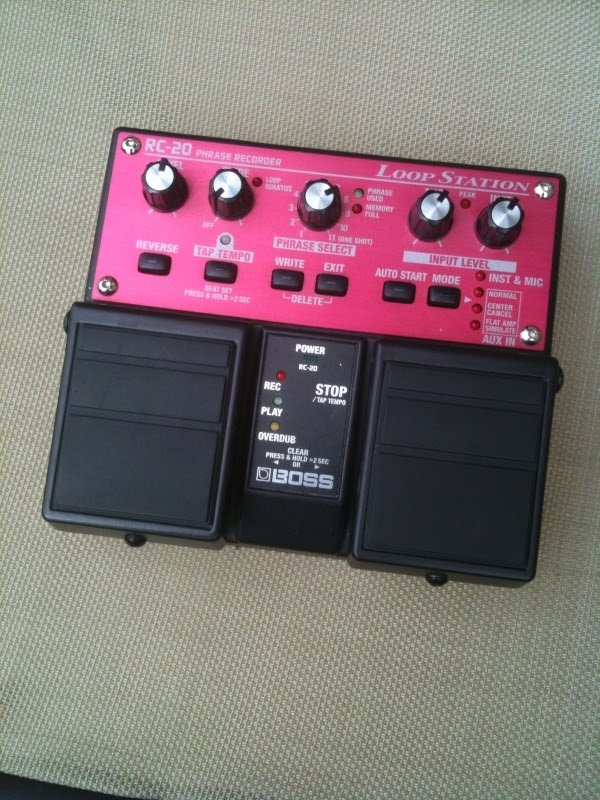
A looping device is also a handy practicing tool. I use the Boss RC-20 Phrase Recorder Loop Station which is a foot-operated looping device.
  • A foot operated looper allows you to record, stop, play, and erase without using your hands. No fumbling for a button while holding a stick or mallet!
  • Easily record and play a part and practice playing over the recorded part. Example: Loop the son clave and practice playing the cascara bell part over the clave.
  • Record a loop of metronome click and record a part that you are practicing. You can listen over and over to check your timing accuracy.

  • The RC-20 has memory capability so you can store your practice loops.


Thursday, July 1, 2010

Expression In Music


How to play musically…only $5 !


“Definite and specific instructions on the playing of music with expression are always needed, and such information should be sought after continually by every serious-minded player as well as by every teacher and director.”

That is the powerful (and truthful) opening sentence from Expression in Music.


Given to me by a mentor years ago, my copy of Expression in Music carries a price marking of $2. The cost has more than doubled yet this inexpensive tome contains a wealth of information on musical phrasing. Famed cornetist, composer, and educator, H.A. Vandercook gives specific directions on emphasis, interpretation, ornamental notes, syncopation, and more. Though published in the 1920’s, the ideas in the book are timeless and can be applied whether playing the lead line or accompaniment.

From Chapter Two:

“With all the high-sounding titles that may be given to it, and no matter how poetically it may be described, expression in music consists of well-placed and intelligent accent or emphasis.”

I recommend investing half a sawbuck and studying the 59 pages of musical wisdom.

Friday, June 25, 2010

Conga Thoughts: Random and Useful

Congas are usually part of my set-up when I am playing Contemporary Worship music but I usually play them sparingly.
  •  Use the basic conga tones to copy phrasing with the other instruments. If the rhythm section plays hits that are short / long / short / long / long /short…try playing slaps for short and open tones for long. A much tighter sound!
  • Avoid playing congas on top of a drumset fill. I look for a musically logical spot to stop the conga pattern before the drummer starts the fill.
  • Muffled slaps played loudly in unison with the snare drum can point up precision problems. Back off on the back beat!
  • When playing “time” on congas, pick a pattern and stick with it. Do not “improv” while the rest of the rhythm section grooves.
  • Pick your spots judiciously. Do the congas really enhance that section?
  • Tune tight for easy response and good projection. Even with amplification, you want to send a solid projecting sound into the microphone.
  • Simple can be effective!  Listen to the congas in “Ain’t Too Proud To Beg”  ...The Temptations version.  You'll see what I mean.  
      

Wednesday, June 16, 2010

Collaborating With Other Art Forms


Painting with Pigment and Percussion
1 Samuel 16:23


Collaborating with artists from art forms other that music has helped me to grow as a musician. Whether dance, poetry, visual art, or drama, I always learn from the experience. Earlier this year, Carlos Cazares and I worked on a project combining painting (Carlos) and percussion (me). The project, A Moment of Relief (1 Samuel 16:23), was different each time we rehearsed or performed.       You can discover more of Carlo Cazares' work at www.carloscazares.com.
 
 
A moment of relief from Carlos Cazares on Vimeo.

Friday, June 11, 2010

Drummer Cafe

Pay a visit…Leave smarter.

My friend (and predecessor as percussion teacher at Christ For the Nations Institute), Bart Elliot is the proprietor /purveyor of Drummer Café. http://www.drummercafe.com/

I am a Tennessean transplanted to Texas. Bart departed his native Lone Star State for Music City several years ago. Our times as percussionists in the Dallas area overlapped for a while. Since moving to Nashville, Bart has established a great source of drumming info on the web. I entreat you to read Bart’s articles, “The Fine Art of Practice” and “In the Pocket.”
Tips, Reviews, Videos…Head on over to Drummer Café.

Wednesday, June 9, 2010

Squeezing The Timpani Part

It calls for four drums but you only have two?


Churches seldom own (or rent) more that two timpani.  Composers and arrangers keep writing for 3-4 drums. In dozens of rehearsals, I have scribbled a few marks on a timp part and managed to perform a satisfactory version with just the 26” and 29” kettles.

Here are some pauken pointers for making do with just two:
 
  • Tune the 29” timpano to E rather that F. This gives you the low resonate E to use rather that just the high (less resonant) E on the 26” drum. Many charts go down to the low E.
  • Switch octaves. If the pitches are Eb - Bb, simply flip it and make it Bb - Eb.
  • Substitute another chord tone. If the chord is D major and the timpani part calls for a D but the pitch change is too clumsy with the two drum set-up, try playing the fifth (A) or the third (F#) if either is more accessible.
  • Use the nodal area. The center of the timp head is a dead zone (very little resonance or pitch). In a rapid passage, some notes can be played in the center to give the percussive sound without a strong definite pitch.
  • Alter the rhythm and /or pitches. A part consisting of four 16th notes (ex. F-G -A -Bb) could be reduced to eighth notes (F -A) or pitches doubled for the 16th effect (F-F-A-A).
  • Delete a passage. Some sections may not lend themselves to editing. Just leave it out. If it is covered elsewhere (bass, tuba, bassoon), just allow that voice to carry the moment.
    Discretion is the better part of valor.
Finally, some advice to help with those quick pitch changes that you will encounter as you reduce the part down to two timps:
  • Sit on a stool so that you can have a foot on each pedal.
  • Tuning Gauges…Get ‘em.  Set ‘em.  Use ‘em.