Photo by Scott Pickering

Saturday, July 24, 2010

Cabasa


  • Strike it.      
  • Scrape it.
  • Shake it.
  • Tap it for staccato.
  • Slide the beads for legato.  


       Lots of possibilities with the cabasa!

     Experiment with these patterns:


Saturday, July 17, 2010

Cajon


"Do you have a box?"

When Robert (a Peruvian) asked that question, I knew that he was referring to the cajon.  Simple, portable, and possessing a variety of timbres, the cajon is a great choice for the "no drumset" situation.  With bass tones produced in the center of the main playing surface (front panel) and crisp highs at the upper corners, you can coax a pretty meaty groove out of the box.

  • Most cajons have screws near the corners of the front panel. Loosen the screws to raise the corners for better slap.  I insert thin cardstock to soup up the slap.
  • Mike the sound hole for good bass tones.  A desktop mike stand comes in handy.
  • A piece of foam rubber resting on the bottom (inside) may help absorb some unwanted ring.
  • Experiment with the cajon for a variety of sounds.  Use the sides.   Play with different areas of your hands, knuckles, fist, etc...  Strike and scrape it with brushes.
  • I prefer a traditional cajon sound (without the snares).  You can obtain the snare effect by placing a snare drum on its side just behind the cajon sound hole.  Face the snare (bottom) head toward the cajon. 
One Good Lick For Cajon:

This pattern outlines the 3:2 son clave.   Start on beat 3 and proceed to beats 4, 1, & 2 and you can get the 2:3  feel.


Saturday, July 10, 2010

Looping Pedal / Practice Tool

Play it again…and again…and again…


Back in my grad school days in electronic comp class, we composed using loops. Those loops were actual magnetic tape loops that we recorded and spliced. We’ve come a long way!

 
Looping is a frequent feature in my solo percussion work and I have also used a looping device in drum circle facilitation.

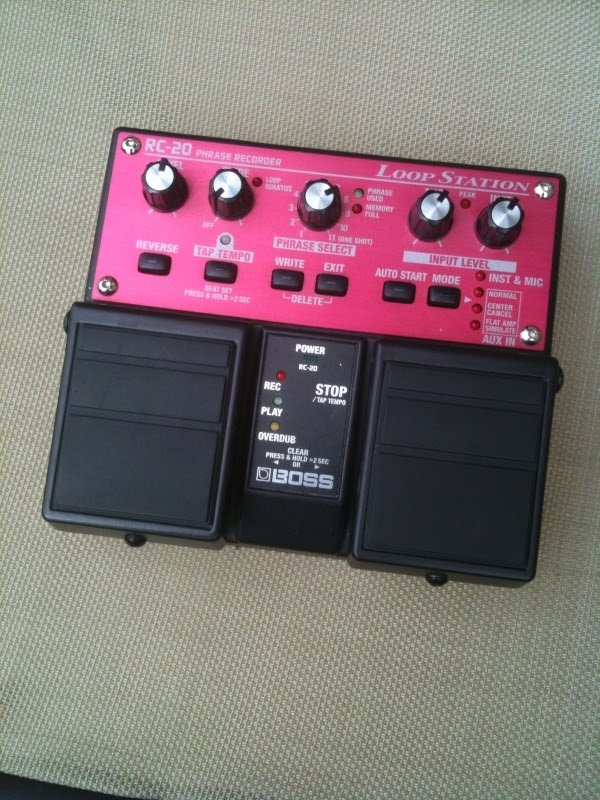
A looping device is also a handy practicing tool. I use the Boss RC-20 Phrase Recorder Loop Station which is a foot-operated looping device.
  • A foot operated looper allows you to record, stop, play, and erase without using your hands. No fumbling for a button while holding a stick or mallet!
  • Easily record and play a part and practice playing over the recorded part. Example: Loop the son clave and practice playing the cascara bell part over the clave.
  • Record a loop of metronome click and record a part that you are practicing. You can listen over and over to check your timing accuracy.

  • The RC-20 has memory capability so you can store your practice loops.


Thursday, July 1, 2010

Expression In Music


How to play musically…only $5 !


“Definite and specific instructions on the playing of music with expression are always needed, and such information should be sought after continually by every serious-minded player as well as by every teacher and director.”

That is the powerful (and truthful) opening sentence from Expression in Music.


Given to me by a mentor years ago, my copy of Expression in Music carries a price marking of $2. The cost has more than doubled yet this inexpensive tome contains a wealth of information on musical phrasing. Famed cornetist, composer, and educator, H.A. Vandercook gives specific directions on emphasis, interpretation, ornamental notes, syncopation, and more. Though published in the 1920’s, the ideas in the book are timeless and can be applied whether playing the lead line or accompaniment.

From Chapter Two:

“With all the high-sounding titles that may be given to it, and no matter how poetically it may be described, expression in music consists of well-placed and intelligent accent or emphasis.”

I recommend investing half a sawbuck and studying the 59 pages of musical wisdom.

Friday, June 25, 2010

Conga Thoughts: Random and Useful

Congas are usually part of my set-up when I am playing Contemporary Worship music but I usually play them sparingly.
  •  Use the basic conga tones to copy phrasing with the other instruments. If the rhythm section plays hits that are short / long / short / long / long /short…try playing slaps for short and open tones for long. A much tighter sound!
  • Avoid playing congas on top of a drumset fill. I look for a musically logical spot to stop the conga pattern before the drummer starts the fill.
  • Muffled slaps played loudly in unison with the snare drum can point up precision problems. Back off on the back beat!
  • When playing “time” on congas, pick a pattern and stick with it. Do not “improv” while the rest of the rhythm section grooves.
  • Pick your spots judiciously. Do the congas really enhance that section?
  • Tune tight for easy response and good projection. Even with amplification, you want to send a solid projecting sound into the microphone.
  • Simple can be effective!  Listen to the congas in “Ain’t Too Proud To Beg”  ...The Temptations version.  You'll see what I mean.  
      

Wednesday, June 16, 2010

Collaborating With Other Art Forms


Painting with Pigment and Percussion
1 Samuel 16:23


Collaborating with artists from art forms other that music has helped me to grow as a musician. Whether dance, poetry, visual art, or drama, I always learn from the experience. Earlier this year, Carlos Cazares and I worked on a project combining painting (Carlos) and percussion (me). The project, A Moment of Relief (1 Samuel 16:23), was different each time we rehearsed or performed.       You can discover more of Carlo Cazares' work at www.carloscazares.com.
 
 
A moment of relief from Carlos Cazares on Vimeo.

Friday, June 11, 2010

Drummer Cafe

Pay a visit…Leave smarter.

My friend (and predecessor as percussion teacher at Christ For the Nations Institute), Bart Elliot is the proprietor /purveyor of Drummer Café. http://www.drummercafe.com/

I am a Tennessean transplanted to Texas. Bart departed his native Lone Star State for Music City several years ago. Our times as percussionists in the Dallas area overlapped for a while. Since moving to Nashville, Bart has established a great source of drumming info on the web. I entreat you to read Bart’s articles, “The Fine Art of Practice” and “In the Pocket.”
Tips, Reviews, Videos…Head on over to Drummer Café.

Wednesday, June 9, 2010

Squeezing The Timpani Part

It calls for four drums but you only have two?


Churches seldom own (or rent) more that two timpani.  Composers and arrangers keep writing for 3-4 drums. In dozens of rehearsals, I have scribbled a few marks on a timp part and managed to perform a satisfactory version with just the 26” and 29” kettles.

Here are some pauken pointers for making do with just two:
 
  • Tune the 29” timpano to E rather that F. This gives you the low resonate E to use rather that just the high (less resonant) E on the 26” drum. Many charts go down to the low E.
  • Switch octaves. If the pitches are Eb - Bb, simply flip it and make it Bb - Eb.
  • Substitute another chord tone. If the chord is D major and the timpani part calls for a D but the pitch change is too clumsy with the two drum set-up, try playing the fifth (A) or the third (F#) if either is more accessible.
  • Use the nodal area. The center of the timp head is a dead zone (very little resonance or pitch). In a rapid passage, some notes can be played in the center to give the percussive sound without a strong definite pitch.
  • Alter the rhythm and /or pitches. A part consisting of four 16th notes (ex. F-G -A -Bb) could be reduced to eighth notes (F -A) or pitches doubled for the 16th effect (F-F-A-A).
  • Delete a passage. Some sections may not lend themselves to editing. Just leave it out. If it is covered elsewhere (bass, tuba, bassoon), just allow that voice to carry the moment.
    Discretion is the better part of valor.
Finally, some advice to help with those quick pitch changes that you will encounter as you reduce the part down to two timps:
  • Sit on a stool so that you can have a foot on each pedal.
  • Tuning Gauges…Get ‘em.  Set ‘em.  Use ‘em.

Thursday, June 3, 2010

As Iron Sharpens Iron... Proverbs 27:17

Tambourine, Conga, Djembe, Cajon, Shaker, Timpani, Cymbals...Hundreds and hundreds of percussion instruments that are available to use in worshipping God! Whether you play congas in contemporary praise & worship music or you are the timpanist playing on hymn arrangements in a more traditional church setting, it is my hope that this blog will be a source of inspiration and information.
As a free-lance percussionist, I have had the opportunity to play percussion in many styles of worship and learn from other percussionists, worship leaders, and producers. As iron sharpens iron (Proverbs 27:17), it is my hope that I can share some of my knowledge and gain some ideas from readers / contributors in the percussion blogopshere. May it all be for the glory of God.


Check back soon.

Wednesday, June 2, 2010

One Hand Cymbal Rolls

“I like what you’re doing. Can you keep that going and throw in a cymbal swell on the modulation?


Playing the shaker with your right hand, you hear the music building to that big climax. If you could just continue the shaker part while adding a crescendo roll on the suspended cymbal…

There are a couple of one handed methods available to make that cymbal roll a reality.

  1. In one hand, hold two mallets using any of the conventional 4-mallet grips (Stevens, Musser, Burton, cross). Spread the mallets to 9:00 and 3:00 on the cymbal and alternate the mallets in the independent roll fashion used in marimba playing. You don’t have to roll very fast to get a good sound.
   2. With palm down, hold the two mallet shafts one over the other in snare drum matched grip with about 2 inches between the mallet heads. With one mallet above the cymbal and one below, use an up and down motion to produce the roll.

I favor Method 1 because of the better tone quality. Either way will allow you to add that roll while continuing to play the instrument in your other hand.

Monday, May 31, 2010

Dynamic Control on Shakers and Tambourines

" ...a little less shaker in this section and fade it at the end of the phrase."

The ability to control an instrument throughout its dynamic range is crucial to good musicianship. Do not overlook this on shakers and tambourines. Practice playing patterns at low volume levels but with the same intensity and consistency as at louder levels. Can you fade up a roll and fade it down smoothly? Try the short exercise demonstrated in this video with tambourines, ganza, maracas, etc… Remember that the tendency is to build crescendos evenly but decrescendos are frequently faded too quickly.

Wednesday, May 26, 2010

Percussion And Drumset Part 1

Playing Percussion While Thinking Drumset


Much of the time when I am playing percussion in a church service, there is also a drumset player. My closest interaction within the rhythm section is with the drummer. The drumset skills developed in high school and college (I still practice drumset and play a few gigs on it these days!) serve me well when I am in the percussionist role. When I am playing percussion, I am often thinking about what the drummer is playing and trying to weave my part around his playing in a complimentary fashion. I can often predict where the drummer will lay down a fill, phrase some horn hits, or play a set up figure. This helps me avoid playing “on top” of a fill or cluttering the phrasing.

Check back soon for Percussion and Drumset Part 2

Friday, May 21, 2010

Worship Team Director DVD / Drums & Percussion

Percussion Ideas For Over 70 Worship Songs

Worship Team Director is a training and presentation tool for your worship team. This project includes video demonstrating how to play the song along with audio options (split tracks, mix minus instrument, etc…).

Produced by Gateway Create Publishing and distributed by Integrity Media, Worship Team Director has a separate DVD for Drums & Percussion. The first three volumes include percussion parts for over 70 songs (demonstrated by Mark Shelton).


I just spent several hours in the studio recording parts for the next volume.  

Tuesday, May 18, 2010

Listening to a variety of music

Celtic to Latin to Rock to Gospel


Arriving early for a rehearsal (always a good idea), I sat in my van listening to the radio. Hearing the entire Carnival Overture by Dvorak, I was impressed by the great writing for  triangle and tambourine.

Listening to a variety of music to learn styles and gather ideas is so important. In today’s worship music, a set might include some Robin Mark, Salvador, Hillsong, Lincoln Brewster, and a little Andre Crouch for good measure. Do you know which instruments to reach for to handle that variety of music…and what kind of part to play? Make listening to different styles a priority.

Demo Video Solo Percussion

Here's about 5 minutes from my solo show

Rainstick Rhetoric

The right amount of rain


On a recent recording, I played the beautiful and fascinating rainstick on the intro and outro of a song. There is more to this instrument than “turn over and let it pour until it stops.”
  • You have to get a long rainstick. Don’t waste your money on a rainstick that will not rain for at least 30 seconds. My rainstick is app. five feet in length.
  • I prefer the natural rainstick made from cactus and pebbles.
  • Find the end that provides the longest “pour” and mark it. Make sure that you load the pebbles into that end before the performance.
  • Practice the rainstick. You can develop some skill with the intensity, dynamics, and controlling the length of time the pebbles are producing sound.
  • Work the mike. Stay close to the microphone but be aware that you can use proximity as a tool.
  • The rainstick is one of those instruments that should be used sparingly. Do not FLOOD the song.

Monday, May 17, 2010

Triangle Tips

Small in size  Packed with power

Listen to a symphony orchestra playing at full volume. Add just one percussionist playing one note on the triangle and hear the sparkling tone shimmer pleasantly over 70+ musicians. Be careful with that power!

There’s not much that you can do to make a triangle sound better…you can’t change the head, put on better snares, etc... You must invest in a quality instrument. One of the favorites in my collection is the 6” Super-Overtone from Grover Pro Percussion (http://www.groverpro.com/). The instrument is rich in harmonics with a good amount of sustain and a tone that is appropriate in a variety of settings.


  • Invest in at least three different sizes of triangle beaters. Each size excites different harmonics thus affecting the tone.
  • Experiment with striking various areas on the triangle for different timbres.
  • My general striking area is the side without the opening. I play about a third of the way down from the top corner with the beater at app. 45 degrees.

    This area gives a less definite pitch with lots of harmonics and blends well with the definite pitched instruments being played.
  •  Always suspend the triangle with TWO separate loops (for safety) of thin string, plastic ties, or fishing line. NEVER use wire or heavy cord that will either buzz or significantly inhibit vibrations. Keep the loops short so that the triangle cannot spin after striking.


Wednesday, May 12, 2010

Roland HandSonic HPD-15

A world of percussion at your fingertips


I am a big fan of the Roland HandSonic HPD-15. This compact electronic instrument was designed with hand percussionists in mind. The unit includes a pressure-sensitive pad divided into 15 zones along with two ribbon controllers and a D Beam. There are over 500 sounds on the HandSonic including acoustic percussion samples from around the world along with vintage drum machine sounds and orchestral instruments. Those sounds are modifiable…imagine a great sounding woodblock that would be better if it could be a half step lower in pitch. With the Handsonic, it takes about 15 seconds for that adjustment!

 
There are several pre-set drum set patches on the Handsonic (or you can build and save your custom “user” patches). The Trigger Input Jack and HH Control Jack allows for pedals so that a percussionist can use hands AND feet to play drumset parts.

I have used the HandSonic to play chimes and timpani with a church choir and orchestra …an easier load-in!

 
Lots of dance/electronic sounds (including turntable scratch samples) are loaded on the HPD-15 along with multi-effects AND a sequencer!

 
More info on this great unit at the Roland website:

www.rolandus.com


Monday, May 10, 2010

Suspended Cymbal Basics

Get The Metal Moving
  1. Use a relatively thin cymbal for suspended cymbal parts.  Some cymbals are marked "suspended" and specifically designed for easy response.
  2. Although it is sometimes necessary in a quick transition, try to avoid using a timpani mallet on the cymbal.  I prefer yarn wrapped marimba mallets for general suspended cymbal playing.
  3. Both rolls and single strikes should be played with the mallets at 3:00 and 9:00 (see photo) for balanced vibrations and quick response.
  4. Priming a cymbal (a gentle inaudible tap with a finger) gets the instrument vibrating for an easier response.
  5. Having an array of implements (sticks, mallets, brushes, dowel rods, triangle beaters. coins) expands the timbral capabilities of the suspended cymbal.

Friday, May 7, 2010

Manipulate Shaker Sound

Change Your Grip / Change Your Tone

Simply grasp the shaker with more of your hand area (or use both hands). The "highs" will be decreased and the tone will be darker.  Loosen your grip and use less hand area to achieve a brighter sound.  You might use a darker tone on the bridge of a song and move to a brighter sound as you proceed to the chorus.  Stay close to the microphone so that the subtle tone shift can be heard.