Photo by Scott Pickering

Wednesday, August 1, 2012

August Set Up Of The Month


Jon E. Kirk ministers from this grand percussion station at Concord First Assembly of God Church.
You can also find Bill Elliot sharing the duties at this multi-timbral playground in North Carolina. 
In addition to his work at the church, Jon serves at a band director / percussion specialist in nearby China Grove, NC.

Keep sending in those photos to Percussion For Worship (markshelton@verizon.net)

Tuesday, July 17, 2012

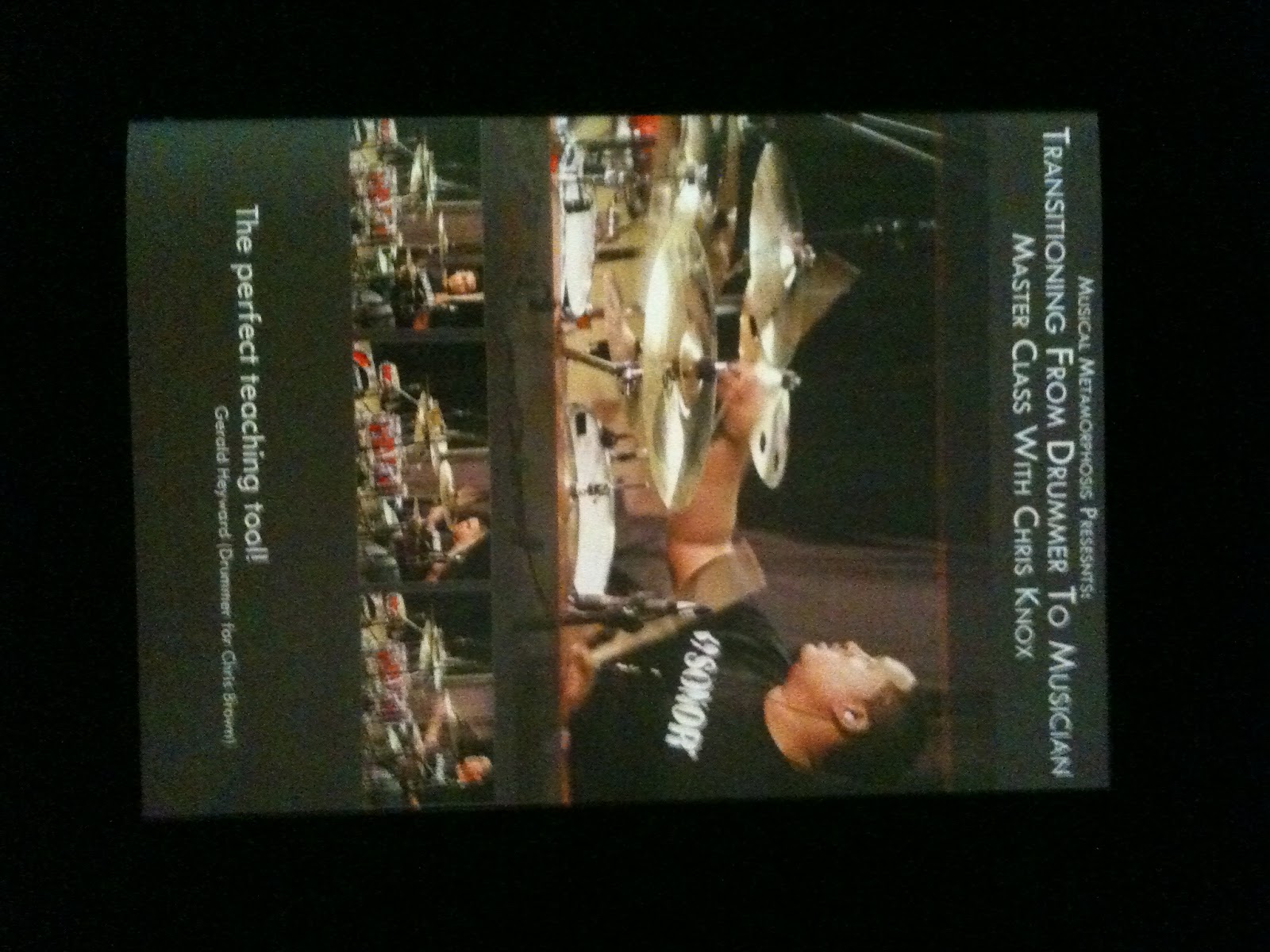
DVD: Transitioning From Drummer To Musician

Whether an absolute beginner or seasoned pro, there is valuable educational material on the new DVD from Chris Knox.  The recent release from Musical Metamorphosis, Transitioning From Drummer To Musician contains instruction on a wide range of topics including grips, set up, fills, rudiments, and developing creativity. 

You'll enjoy Chris Knox throwing down (with taste) on a few songs backed by a highly skilled band. The Texas musician gives you ample servings of knowledge on this info packed disc.   The DVD is just under two hours AND includes downloadable exercises in PDF format.

Solid teaching, practical info, and inspiring playing!

Check out www.chrisknox.net for more info.

Tuesday, July 3, 2012

Stick Control


Among the hundreds of percussion instructional books available, there are several "classics" of teaching texts.   Stick Control is a favorite of mine and the "tape repair job" on my personal copy bears witness to the many times it has been used in my drumming career.  For three quarters of a century, drummers have sharpened their skills with this famous educational opus by George Lawrence Stone. Stick Control contains material that can benefit ANY percussionist (drum set player, hand percussionist, mallet player, orchestral percussionist, or drum circle enthusiast).   The first nine pages of exercises alone can increase your playing level.  Mr. Stone's tome gives variation upon variation of sticking patterns for many basic rhythms.   The exercises can be played with sticks on a single surface, executed on multiple surfaces (giving you some ideas for fills), and played with brushes "sliding" the patterns (an idea from drum set great Ed Soph).

Stick Control is currently published by Alfred Music.

Wednesday, June 27, 2012

Song Of Truth Fast Tempo

Jonathan Malone (songwriter, worship leader, and pal 'o mine) wrote this with a little help from me.
No percussion on this demo version...If you were adding some percussion, what would be your choices? Comments?


Listen    Enjoy    Worship      Tell a friend


Wednesday, June 20, 2012

June Set Up Of The Month


Percussionist Marlon Lewis shared these photos of his set up.  The Maryland musician has the goods to groove AND create some color with Mark Tree, Rain Stick, Chajchas, Togo Seed Rattle, Thunder Tube tm , and Finger Cymbals.


Friday, June 15, 2012

Creativity


Steve Jobs said,  "Creativity is just connecting things."

That statement has the ring of truth.  Keep in mind that you have to collect those "things" so that you can have a stockpile in your brain at the ready when the creative moment is needed.  That is why it is important  to explore and grow as musicians.  LIsten to different styles of music...including pieces WITHOUT percussion. Check out methods of playing other than your favorites.  Read up on the newest innovations that you cannot afford...yet!  Attend concerts and clinics presented by great players that will inspire (and humble).

This "collecting for connecting" extends outside of music.  Studying other fields (history, visual art, dance, math, astronomy) can spark creativity in music.  

Devote some of your practice time to creativity. Improvise. 

As percussionists, our number of instruments keeps growing, the sources of educational media increases, and players continue to push the technical limits.


Be a lifelong learner.

Connect and Create !


Intelligent people are always ready to learn.  Their ears are open to knowledge.

Proverbs 18:18 New Living Translation
Scripture quotation from the Holy Bible, New Living Translation, copyright ©1996, 2004, 2007 by Tyndale House Foundation. Used by permission of Tyndale House Publishers, Inc., Carol Stream, Illinois 60188. All rights reserved.

What techniques do you use to spark creativity?


Thursday, June 7, 2012

Thursday, May 24, 2012

Tambourine Energy Boost

You're playing that smokin' sixteenth tambourine pattern on the last part of the song and you know that final chorus  should go up a notch in intensity.  

What can you do?

Here's an idea:
Keep the sixteenths going and toss in some accented upbeats.  Experiment with accents on the upbeat of one and three (similar to hi-hat opens) or on the "and" of all four beats...or some other variations.  
It doesn't work on every song but when it does...POW! 
You can really feel the tambourine give an extra "lift" to the overall groove.

Tuesday, April 17, 2012

Eric Darken Interview

Eric Darken's percussion has been a part of hundreds of recordings over the last few decades.  The Nashville session great took a few moments recently to answer a few questions:

Mark:  What is your background / training as a percussionist?

Eric:  I started out playing drum set at the age of twelve.  I played timpani and mallets in high school.  I attended Brevard College in North Carolina and studied with Mario Gaetano who was a wonderful orchestral percussionist and educator.  He really got me started into the whole orchestral percussion world.  After a two year degree, I transferred to Oral Roberts University in Tulsa, OK.  There I studied with Roy Smith who was the principal percussionist for the Tulsa Philharmonic.  At ORU, I was asked to be a part of the Richard Roberts "live" TV show which aired five days a week.  This was a great experience because it taught me how to sightread and perform charts very quickly.  We would rehearse a few songs for the show and then tape "live" an hour later.  This was not only a wonderful experience, but quite an education.

How about name dropping some artists with Eric Darken percussion on their recordings?

I have had the opportunity over the years to record for a variety of artists and bands.  Steven Curtis Chapman, Amy Grant, Michael W. Smith, Gaither Vocal Band, Taylor Swift, Bob Seger, Keith Urban, Carrie Underwood, Bon Jovi

You've been involved in a variety of aspects of the music business.  In addition to playing percussion, what else have you done in your career?

I started out years ago copying music for various music arrangers.  It was a lot of hard work and long hours but I learned a lot by doing it.  Over the years, I have composed music for TV and film and continue to do so as time permits.  You can hear some of my music on such television shows as Dateline, 20/20, NFL Films, National Geographic, and Fox Sports.

How has your work as a percussionist changed / evolved over the course of your career?

I'm always trying to learn and grow as a musician and by doing so that includes keeping up with the electronic world as well.  Years ago, I began recording projects of my own in my studio and that has moved into people sending me their tracks to play on .  I'm constantly trying to stay up to date with the latest recording and software gear.  I do the same with my acoustic percussion as well.  My set up incorporates both acoustic and electronic options.  I use samples and can create original loops in the studio as needed.  On any given day or song, I can incorporate all types of percussion, some electronics and even some drum set parts if needed.  By having my own studio, it forced me to not only keep up with things percussion-wise but also recording as well.  There is always something to learn!

I'm sure that there are many times in the studio (or preparing for a live event) when there is no written chart.  What is your method for creating a percussion part?

I don't have a formula per se when there is no written part.  I try to communicate with the artist or producer on what he or she might like or what they want to accomplish with percussion.  A lot of times, a producer will give specific instructions or often times, they will just tell me to "do my thing."  I try to listen to the "big picture" with a track.  If there is a lot of motion going on within the track then I might adjust what I do from a shaker or hand drum part.  I tend to try to blend into what the drums are doing and not stick out in any way...even if there are a bunch of different parts!  Ultimately, I would like to believe that what I bring to a track is inspired by God.

Eric uses Meinl Percussion, Paiste Cymbals, Mike Balter Mallets, Remo Heads, and the Trash Kat Drum from ThunderEcho Drums.


Monday, March 19, 2012

Caxixi

The caxixi is a percussion instrument traditionally made with a woven basket cone attached to a circular piece of gourd.   The gourd functions as the primary striking surface.  Some modern versions use plastic or metal instead of gourd.   The instrument contains some type of "fill" material (beads, seeds, shot, etc...).  Sound is produced by the fill contacting the gourd surface when the instrument is shaken.  There is some ancillary sound from the fill striking the basket.

I dig the earthy and slightly imprecise sound of the attack as the fill strikes the slightly convex surface.

Holding a basket in each hand allows the player to play fairly complicated rhythms.  Playing a simple downbeat pattern along with a drumset "toms groove" can lend a raw ethnic flavor.   Try holding three or four to get a big sound.

Are there some creative ideas that you'd like to share about the caxixi?  Comment below.

Monday, March 12, 2012

Spherical Shaker To The Rescue

Your choice of a shaker is usually guided by the tone that is appropriate to the music.   Sometimes logistics and convenience must have a say in the decision.  A spherical (round ball) shaker can be a handy friend in some tricky settings. 

With prism and cylinder shakers, you have to make sure that the instrument is parallel to the floor for a "straight feel."  With a sphere, it is not so much of an issue. 

Recently I had to play (LIVE) a shaker pattern with my right hand and a cajon bass / slap rhythm with my left.  The shaker in the picture worked great...a good timbre and I could give my attention to the cajon without having to think much about the shaker angle.  

One more thing...in a quick instrument switch, a spherical shaker can be easier to pick up and move into playing position.

I keep this one in my mallet case.  
Whatdayathink?  Comments? 

Monday, February 20, 2012

Rock The Glock

Call it the orchestra bells, glockenspiel, campanelli, or just plain "bells"---- It's an IN sound.  You hear the metal-barred cousin to the xylophone in pop and alt rock (or Pomplamoose) these days...and worship music.  

You might consider investing in a set of bells.   They can come in handy in a variety of musical situations--- choir anthems, cantatas, hymns, and worship songs.

Glockenspiels come in two flavors: Steel and Aluminum
Steel:  Best sound, Heavy, Pricey
Aluminum: Sounds okay until you hear steel, Lightweight, Easier on the budget

Some bands use the bells from beginner percussion kits.  It works.  Mike 'em up and throw on some reverb.  You can get the desired effect.

My "gig glock" has aluminum bars mounted in a case which reflects the sound (like a resonator).

Check out the song, "When I'm With You" from the Great Great God CD from Gateway Worship.   About three minutes into the song, many instruments (guitars, bass, keys) play a melody in octaves.  After a couple of statements of that melody, I bring in the glockenspiel to give the passage that sparkling punch that the bells can deliver.


Monday, January 30, 2012

The Shake Tambourine's Old Testament Cousin

King David and his companions were obviously excited about 
bringing the Ark of the Covenant back to Jerusalem.  In the 
procession, a number of instruments are being played 
according to Scripture:
"And David and all the house of Israel played before the 
LORD on all manner of instruments made of fir wood, even on 
harps, and on psalteries, and on timbrels, and on cornets, 
and on cymbals."                               2 Samuel 6:5 KJV
My research indicates that the band for this event may have
included a distant relative to the shake tambourine.
Some versions of the Bible use the word, castanets instead
of cornets (as the above KJV).
"This word (castanet) is incorrectly translated “cornets” in 
the King James Version.  The castanet was probably about 
the same instrument as the Egyptian sistrum…a loop-shaped 
metal frame through which were passed loose rods at the 
ends of which were rings.  The instrument was held by a 
long handle and was rattled during songs and dances." 
  
Fortune, A.W. "Castanets,"  The International Standard Bible Encyclopedia. 
edited by James Orr.  Grand Rapids, Michigan: by William D. Eerdmans 
Publishing, 1939
The sistrum seems to be a Biblical percussion instrument
with a sound and playing technique that resembles the shake
tambourine.  

Tuesday, January 17, 2012

Which Backbeat To Play?

...2 or 4?

Doubling the snare drum back beat with a single strike on the tambourine is quite common and can give some variety to the groove. I usually choose one backbeat or the other; seldom do I play both 2 and 4. Less tedium and greater variety occurs when the snare drum is heard alone on one of the beats and the doubled sound on the other. Sometimes my choice is arbitrary but often I make a studied decision based on the lyrics of the song.

Listen to the phrasing of the lyrics and you will often find less vocal activity around either beat 2 or beat 4. Playing on that back beat allows the tambourine’s tone color to do its job without competing with the vocals.

Both lyric and tambourine get their space.

Monday, January 16, 2012

Percussion How To Series

My video series, Percussion How To is on the web.   Check out these short video tutorials at either www.youtube.com/marksheltonmusic or www.percussionhowto.blogspot.com .

Here's a sample:

Monday, January 9, 2012

January Set Up of the Month

Percussion For Worship featured an interview with Len Barnett (percussionist with Daystar Television) back in November 2011.
Check out the arrangement of gear for his work on Celebration.

I want to jump into the photo and start improvising!


Thursday, January 5, 2012

Alt Rock Cajon

This Alt Rock Groove for cajon was inspired by the drum set version found on Carl Albrecht's DVD Drum Grooves for Worship.
See Posting December 13, 2011

The notes in parentheses are ghosted (played very lightly).  
Bottom space in cajon staff is the bass tone (center) and top space is the slap tone (corner).

Wednesday, January 4, 2012

Percussion For Worship Tribe

It's exciting to see how many page views that Percussion For Worship has received since the launch in 2010.   It is my desire that this blog brings you information and inspiration for your ministry (whether you are a percussionist, worship leader, producer, songwriter, or just interested in percussion).

How about your ideas?  What do you want to see in upcoming posts?  Do you want to be a guest writer?  How about sending in a photo of your set up? 

Please send your suggestions to me at markshelton@verizon.net or post in the comments section on the blog.

Be a part of the Percussion For Worship tribe !

Wednesday, December 21, 2011

December Set Up of the Month: Greg Draper

Check out this set up photo (and comments below) from Greg Draper, a percussionist at Hallmark Baptist Church in Fort Worth, Texas. 

I've attached a photo of my complete gig rig. I don't usually play all these instruments in a service, but have them available if needed. You can see in the photo the pair of mini-timbales and the pair of regular timbales. I play these with my hands to insert a fill, roll, or accent where needed. It's fun to be playing along on the congas and bongos with their warm tones and then insert a quick fill on the metallic-sounding timbales for contrast. Playing seated with the congas gives me easy access to my tambourine, block, and bass drum pedals. I also like to play a bit of  bass drum to fill in the bottom end.

Monday, December 19, 2011

The Many Moods of Christmas

Christmas is coming!   My hands were full this past weekend as I played percussion on The Many Moods of Christmas (Suites 1 & 2) at Plymouth Park United Methodist Church in Irving, TX.   Jason Chavarria conducted the choir and orchestra in these classic settings by Robert Shaw and Robert Russell Bennett.  The percussion part is scored for a section of about four players.  I employed a few tricks of the trade (including playing timpani on the Handsonic) and covered most of the parts.   Challenging...but fun (and musically satisfying) !