
The new album from Zach Neese has been released. I'm honored to be playing percussion on this project.
Lots of percussion...AND there's also some drumline work. Tim Cruz, Caleb Jobe, and I got to flex our rudimental chops and lock in some rolls on the opening track, "We Trust in Jesus." God and King is available from iTunes.
Thursday, September 15, 2011


Friday, September 9, 2011
Featured Set Up September 2011
 Percussion For Worship reader, Chuck George recently sent a picture of his set up at Calvary Assembly of God in Orrville, Ohio. Chuck's arsenal includes 16" thin crash cymbal, 16" Chinese cymbal, 18" crash/ride cymbal, bongos, congas, djembe, triangles, shaker, egg shakers, bar chimes, mounted tambourine, woodblock, cowbells, timbales, cajon, and rainstick. In addition to his percussion duties, Chuck is also active in an endurance athletics ministry.
Friday, September 2, 2011
Waiting For Beat Two
"Waiting for beat two" is a widely accepted performance practice in drumset playing.
When the drummer ends a phrase and moves to a new section with a fill (and plays a cymbal crash on beat one), the full drumset groove often does not resume until beat two. (There are exceptions.)
As a percussionist, you can take advantage of waiting for beat two. When you encounter that musical moment when it is a challenge to make that logistical change (a good example: switching from shake tambourine to congas), you might be able to buy yourself another half second or so by waiting for beat two.
Listen carefully to make sure it works with both the drumset and the overall phrasing.
It's surprising how that extra moment can make the difference between an awkward thrash and a smooth transition between instruments.
When the drummer ends a phrase and moves to a new section with a fill (and plays a cymbal crash on beat one), the full drumset groove often does not resume until beat two. (There are exceptions.)
As a percussionist, you can take advantage of waiting for beat two. When you encounter that musical moment when it is a challenge to make that logistical change (a good example: switching from shake tambourine to congas), you might be able to buy yourself another half second or so by waiting for beat two.
Listen carefully to make sure it works with both the drumset and the overall phrasing.
It's surprising how that extra moment can make the difference between an awkward thrash and a smooth transition between instruments.
Thursday, August 18, 2011
Bring "Ears"
 With so many situations that eschew wedges in favor of in-ear monitors and recording sessions taking place in non-conventional settings, I always bring some “ears” to gigs. You cannot count on every venue to provide some “cans” or “buds.” Have your own set at the ready.
I was hired for a session by an artist that was recording on a laptop studio. Just before I left my home, I noticed my headphone extension cable coiled on a stand. I decided that it would not be needed.
To my dismay, the artist/engineer had brought only one set of headphones to the session. Good thing that I had my set… but that extension would have sure come in handy.
Always bring the ears…and maybe an extension.
Monday, August 8, 2011
Stuff That Lives In My Mallet Case
Timpani sticks might stay on a shelf until I get a "kettle call" and the general bass drum mallet only goes into my case when Gran Cassa is on the menu.
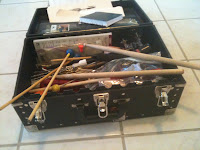 There are some items that are used so frequently that they have made my mallet case their permanent residence.
Here is a baker's dozen of those occupants:

Here is a baker's dozen of those occupants:
- Concert snare sticks
- Drumset sticks
- Yarn marimba mallets (for suspended cymbal)
- Brushes
- Triangle beaters
- Drum key
- Pencil(s)
- Glockenspiel mallets
- Xylophone mallets
- 1/2 inch wrench (for tuning congas, bongos, & timbales)
- Staff paper
- Notebook
- Djembe tuning wrench
Friday, July 29, 2011
Did The Tambourine Modulate?
 Try this one... Switch tambourines as a song modulates to a higher key. Moving from a darker to a brighter sounding instrument gives the impression that the tambourine is changing key along with the band!
Friday, July 22, 2011
Listening To A Variety Of Music
Celtic to Latin to Rock to Gospel
Arriving early for a rehearsal (always a good idea), I sat in my van listening to the radio. Hearing the entire Carnival Overture by Dvorak, I was impressed by the great writing for triangle and tambourine.
Listening to a variety of music to learn styles and gather ideas is so important. In today’s worship music, a set might include some Robin Mark, Salvador, Hillsong, Lincoln Brewster, and a little Andre Crouch for good measure. Do you know which instruments to reach for to handle that variety of music…and what kind of part to play? Make listening to different styles a priority.
Tuesday, July 19, 2011
See What Ya Got
Triangle beaters, knife, timpani tuning key, pencil sharpener, tape, conga wrench, felt tip pen...

Do you ever have to rummage through your mallet case or stick bag to find those little items?
Get the gallon size "zipper" freezer bags and you can keep that stuff in one place and easily see what you've got at a glance.

Do you ever have to rummage through your mallet case or stick bag to find those little items?
Get the gallon size "zipper" freezer bags and you can keep that stuff in one place and easily see what you've got at a glance.
Friday, July 8, 2011
Triangle Tips
Small in size Packed with power
Listen to a symphony orchestra playing at full volume. Add just one percussionist playing one note on the triangle and hear the sparkling tone shimmer pleasantly over 70+ musicians. Be careful with that power!
There’s not much that you can do to make a triangle sound better…you can’t change the head, put on better snares, etc... You must invest in a quality instrument. One of the favorites in my collection is the 6” Super-Overtone from Grover Pro Percussion (http://www.groverpro.com/). The instrument is rich in harmonics with a good amount of sustain and a tone that is appropriate in a variety of settings.
Listen to a symphony orchestra playing at full volume. Add just one percussionist playing one note on the triangle and hear the sparkling tone shimmer pleasantly over 70+ musicians. Be careful with that power!
There’s not much that you can do to make a triangle sound better…you can’t change the head, put on better snares, etc... You must invest in a quality instrument. One of the favorites in my collection is the 6” Super-Overtone from Grover Pro Percussion (http://www.groverpro.com/). The instrument is rich in harmonics with a good amount of sustain and a tone that is appropriate in a variety of settings.
- Invest in at least three different sizes of triangle beaters. Each size excites different harmonics thus affecting the tone.
- Experiment with striking various areas on the triangle for different timbres.
 My general striking area is the side without the opening. I play about a third of the way down from the top corner with the beater at app. 45 degrees.
This area gives a less definite pitch with lots of harmonics and blends well with the definite pitched instruments being played.- Always suspend the triangle with TWO separate loops (for safety) of thin string, plastic ties, or fishing line. NEVER use wire or heavy cord that will either buzz or significantly inhibit vibrations. Keep the loops short so that the triangle cannot spin after striking.

Thursday, July 7, 2011
Zach Neese: In The Studio
Worship Leader / Songwriter, Zach Neese recently brought me into the studio for several hours of percussion recording for his solo project. Check out this video produced by Corey Jackson:
Zach Neese: In The Studio Part 3 from Corey Jackson on Vimeo.
Zach Neese: In The Studio Part 3 from Corey Jackson on Vimeo.
Friday, July 1, 2011
Featured Setup

 Here are a couple of pictures from one of the Percussion For Worship readers. The photos show some details from the setup of John Homan, percussionist at New Creation Fellowship in Granger, Indiana. John's generosity in sharing these with the readers gives me the idea to feature some photos from other worship percussionists. Just send your pix to markshelton@verizon.net and be sure to include the name of your church.
Friday, May 27, 2011
Setup for Great, Great God EP

Wow! Recording six songs LIVE for the Gateway Worship EP meant bringing in more gear that usual. Percussion instruments in my setup included snare drum, Chinese bell tree, suspended cymbals, two floor toms, mark tree, shekere, cabasa, shakers, crash cymbals, triangles rack, and tambourines. Once everything was set up...it was a percussion playground!
Conga Ideas: Random and Useful

- Use the basic conga tones to copy phrasing with the other instruments. If the rhythm section plays hits that are short / long / short / long / long /short…try playing slaps for short and open tones for long. A much tighter sound!
- Avoid playing congas on top of a drumset fill. I look for a musically logical spot to stop the conga pattern before the drummer starts the fill.
- Muffled slaps played loudly in unison with the snare drum can point up precision problems. Back off on the back beat!
- When playing “time” on congas, pick a pattern and stick with it. Do not “improv” while the rest of the rhythm section grooves.
- Pick your spots judiciously. Do the congas really enhance that section?
- Tune tight for easy response and good projection. Even with amplification, you want to send a solid projecting sound into the microphone.
- Simple can be effective! Listen to the congas in “Ain’t Too Proud To Beg” ...The Temptations version. You'll see what I mean.
Thursday, May 26, 2011
It's okay to not play
How can they miss you if you never go away?
As percussionists, we have the ability to change the timbral texture of the ensemble with our variety of sounds and instruments but always remember that we can also change the sound by not playing. You can increase your impact by dropping out for a while. Demonstrate your taste and restraint with the confidence that the decision not to play IS a musical decision. Try waiting until the second verse to enter or maybe that intro with piano doesn’t need those triangle notes on top (or fewer). Sometimes…less is more.
As percussionists, we have the ability to change the timbral texture of the ensemble with our variety of sounds and instruments but always remember that we can also change the sound by not playing. You can increase your impact by dropping out for a while. Demonstrate your taste and restraint with the confidence that the decision not to play IS a musical decision. Try waiting until the second verse to enter or maybe that intro with piano doesn’t need those triangle notes on top (or fewer). Sometimes…less is more.
Thursday, May 5, 2011
Searching for Sounding Metal in the Scriptures
According to Strong’s Exhaustive Concordance of the Bible, cymbals are mentioned sixteen times in the King James Version. Fifteen of those are found in the Old Testament while the singular form (cymbal) occurs just once in the New Testament.
Check out this passage:
And he appointed certain of the Levites to minister before the ark of the Lord, and to record, and to thank and praise the Lord God of Israel:
Asaph the chief, and next to him Zechariah, Jeiel, and Shemiramoth, and Jehiel, and Mattithiah, and Eliab, and Benaiah, and Obededom: and Jeiel with psaltries and with harps; but Asaph made a sound with cymbals;
Benaiah also and Jahaziel the priests with trumpets continually before the ark of the covenant of God.
1 Chronicles 16: 4-6 KJV
I get a kick out of reading that Asaph was both the bandleader and percussionist of this large combo.
Friday, April 29, 2011
Tambourine Shuffle
When playing a shuffle or swing feel, hold the tambourine shell parallel to the floor with your palm facing up. The motion of the tambourine will be up and down rather than side to side. Play the strong subdivisions with a DOWN motion and the weaker subdivisions with the UP motion. You will notice how easily the shuffle happens due to this position (and good ole gravity). The tambourine shell strikes the fingers of the free hand for a accent on the DOWN motion and the heel area for UP accents.
Tuesday, April 5, 2011
Get The Metal Moving
Both rolls and single strikes should be played with the mallets at 3:00 and 9:00 (see photo) for balanced vibrations and quick response.
 Priming a cymbal (a gentle inaudible tap with a finger) gets the instrument vibrating for an easier response.
Use a relatively thin cymbal for suspended cymbal parts. Some cymbals are marked "suspended" and specifically designed for easy response.
Although it is sometimes necessary in a quick transition, try to avoid using a timpani mallet on the cymbal. I prefer yarn wrapped marimba mallets for general suspended cymbal playing.
 Priming a cymbal (a gentle inaudible tap with a finger) gets the instrument vibrating for an easier response.
Having an array of implements (sticks, mallets, brushes, dowel rods, triangle beaters. coins) expands the timbral capabilities of the suspended cymbal.
Tuesday, March 29, 2011
Tambourine Timbres
Plastic shell with nickel jingles or brass…or maybe wooden shell with German silver?
Sometimes I bring 4 or 5 tambourines to a rehearsal so that I can fit the tone of the instrument to the texture of the music that I am playing and /or to give some variety. Different shell materials influence the sound as well as the makeup of the jingles. Brass jingles tend toward a darker sound and seem to give off more of the “Rock” sound while nickel jingles are brighter and might be a good choice to give some sparkle and drive to a ballad. I have even set up a tambourine with a combination of jingles and washers to get a tight “dry” sound. During a rehearsal, play along for a few measures with one tambourine and then switch to a different one. You will probably hear the sound of one of the instruments fit better into the overall texture of the surrounding music.
One of my tricks is to switch tambourines as a song modulates. Moving from a darker to a brighter sounding instrument gives the impression that the tambourine is changing key along with the band!
Monday, March 28, 2011
Gateway Training Videos for God Be Praised CD
Worship Team Director is a complete training and presentation tool for worship teams that instructs team members how to play and sing songs at home, in rehearsal, and performance. For more info www.worshipteam.tv
Check out the percussion video for O The Blood...played by Headless Percussionist and Blogger, Mark Shelton.
Go to www.youtube.com/gatewayworship for a full screen.
More videos at www.youtube.com/gatewayworship
Check out the percussion video for O The Blood...played by Headless Percussionist and Blogger, Mark Shelton.
Go to www.youtube.com/gatewayworship for a full screen.
More videos at www.youtube.com/gatewayworship
Thursday, March 24, 2011
Balancing Act
While subbing in the North Carolina Symphony, I noticed another percussionist's unorthodox method of suspending a cymbal. Instead of using a conventional stand to hold the instrument while playing, my colleague balanced the cymbal on his finger and performed both rolls and single strikes using his other hand (holding two mallets). I quickly put this technique into my bag of tricks and have used it many times.
- The cymbal can resonate more freely (no felt pads or plastic sleeve to inhibit vibrations).
- In acoustic settings, you can lift the cymbal higher for better projection (over the heads of those violinists seated in front of you).
- In amplified situations, you can "work the mike" (bringing the cymbal farther or closer with ease).
- This method allows the audience to "see" the sound better.
- It might mean one less stand in your set-up.
Subscribe to:
Posts (Atom)

